Diamond Bar Wood Flooring provides hardwood floor installation in Diamond Bar, CA, backed by more than 20 years of installing, sanding and finishing wood floors, and we serve surrounding cities including Walnut, Rowland Heights, South San Jose Hills, Pomona and Brea. A new hardwood floor should stay flat, quiet and tight for decades, and whether it does is decided mostly by work you never see once the boards are down.
In Diamond Bar, where most houses were built in the 1970s and 1980s, installation often follows removal of worn carpet, old vinyl or tile. That tear-out reveals the real starting point: a plywood subfloor that may need refastening, a slab that needs moisture testing, or an older adhesive that needs to be sampled before anyone scrapes it.
We plan each installation from that starting point. The species, construction, installation method and finish are all chosen to suit your subfloor, your rooms and how your household uses them.
Choosing the Right Hardwood
Solid Hardwood Flooring
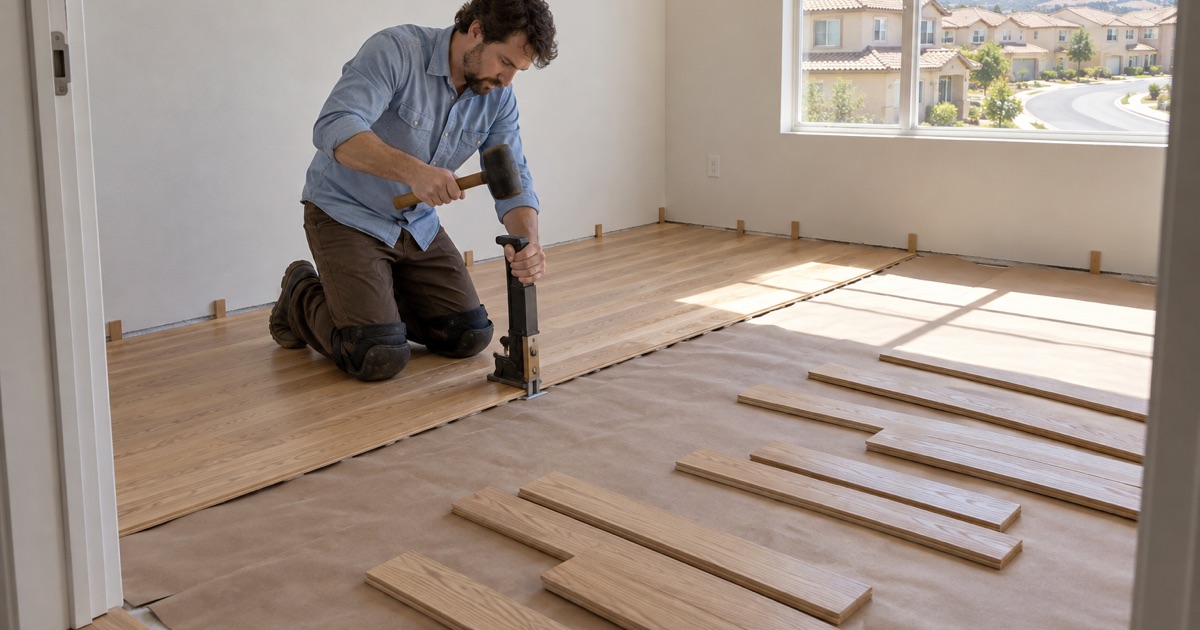
Solid hardwood is milled from a single piece of wood and can be sanded and refinished many times over its life. It is typically nailed down over a plywood or OSB subfloor using flooring cleats or flooring staples. Because it expands and contracts with seasonal humidity, proper moisture testing and expansion gaps are essential. Solid floors can be installed unfinished and site-finished, which allows any stain color and a smooth surface across the joints.
Engineered Hardwood Flooring
Engineered hardwood has a real wood wear layer over a plywood or composite core, making it more stable than solid wood as humidity changes. It can be glued down over concrete, floated over an underlayment, or nailed over wood subfloors. Composite cores in engineered flooring sold in California must meet CARB Phase 2 or TSCA Title VI formaldehyde standards, which we confirm on product labels.
Species, Grade and Cut
Red oak and white oak are dependable, easy to refinish and widely available. Hickory and maple rate higher on the Janka hardness rating, resisting dents better, though maple can blotch under dark stain. Plain-sawn boards show cathedral grain, while rift-sawn and quarter-sawn boards have straighter grain and are more stable. Select grade gives a uniform look, and character grade shows knots and color variation.
Preparing the Subfloor and Slab
Removing Old Flooring Safely
Carpet, pad and tack strip come out first, followed by any old vinyl or tile. South Coast AQMD Rule 1403 requires an asbestos survey before renovation, covering all layers of flooring materials down to the joist level, subject to its narrow exemptions. We have older resilient flooring and dark adhesives sampled before they are removed, and asbestos abatement, when needed, is handled by a qualified abatement contractor.
Flattening and Fastening the Subfloor
We screw down loose subfloor panels to the floor joists to prevent squeaks, plane down high seams and fill low areas. Soft or water-damaged sections are cut out and replaced with matching plywood or OSB. National Wood Flooring Association installation guidelines treat subfloor flatness and fastening as part of a proper installation, and skipping this preparation is the most common reason new floors squeak or develop gaps.
Moisture Testing Wood and Concrete
Wood subfloors and new flooring are both tested with a pin moisture meter so their moisture content is close before installation. Concrete slabs get an in-situ relative humidity test following ASTM F2170, which reads moisture inside the slab rather than at the surface. The results decide whether a vapor retarder or moisture-control adhesive is needed.
Installation Methods
Nail-Down Installation
Nail-down installation fastens tongue-and-groove boards to a wood subfloor with flooring cleats or staples driven at an angle through the tongue. It is the traditional method for solid hardwood and gives a firm, solid feel underfoot. We follow fastener spacing and expansion gap guidance for the product being installed.
Glue-Down Installation
Glue-down installation bonds engineered boards directly to a concrete slab or wood subfloor with a flooring adhesive matched to the product and the moisture readings. It is common over slabs and gives a solid, quiet floor. Surface flatness matters more here, because boards follow any dip in the slab.
Adhesive coverage is the other half of a lasting glue-down floor. We spread with the trowel size the adhesive maker specifies, check transfer by lifting a board early in the job, and roll or weight areas where boards want to lift. Hollow spots found a year later almost always trace back to adhesive that never made full contact.
Floating Installation and Underlayment
Floating floors lock or glue together at the joints and rest on an underlayment rather than being fastened to the subfloor. They install quickly and suit some slab and condo applications. In multi-unit buildings, a sound-rated underlayment is often required, and the impact insulation class or sound transmission class rating needed comes from the association’s rules.
Finishing Details
Transitions, Thresholds and Stairs
Where hardwood meets tile, carpet or a different floor height, we install T-molding, reducers or thresholds milled to match the species. At stairs, a flush stair nosing creates a clean edge from the upper floor to the first step, and stairs are priced tread by tread.
Site-Finished or Prefinished
Prefinished flooring arrives with a factory finish, often aluminum oxide, and can be walked on soon after installation. Site-finished flooring is sanded flat and finished in place, allowing custom stain colors and a seamless surface, though the house needs to be planned around sanding dust and cure time. Site finishes we apply fit the South Coast AQMD Rule 1113 VOC limit for wood coatings.
Checking a Contractor’s License
The Contractors State License Board lets you search a contractor by license number, business name or personnel name and review complaint disclosures. Flooring work falls under the C-15 flooring and floor covering classification. It takes only a few minutes and is worth doing before any installation contract is signed.
- 20+ Years of Wood Floor Work
- Free In-Home Estimates
- Dust-Contained Sanding