
Diamond Bar Wood Flooring installs and refinishes hardwood stair treads in Diamond Bar, CA, drawing on more than 20 years in hardwood work, and we serve surrounding cities including Walnut, Rowland Heights, South San Jose Hills, Pomona and Brea. Stairs are the most visible woodwork in a two-story house, and they are also where carpet wears out first.
In a city where most houses date from the 1970s and 1980s, a carpeted staircase is a common holdover from the original build. Owners who have already replaced the downstairs carpet with hardwood want the stairs to match, and worn stair carpet rarely does.
We price stairs step by step. Each tread, riser, nosing and landing is its own line on our estimate, because a staircase takes far more cutting and fitting than any square-foot price can show.
Converting Carpeted Stairs to Hardwood
What Is Under the Carpet
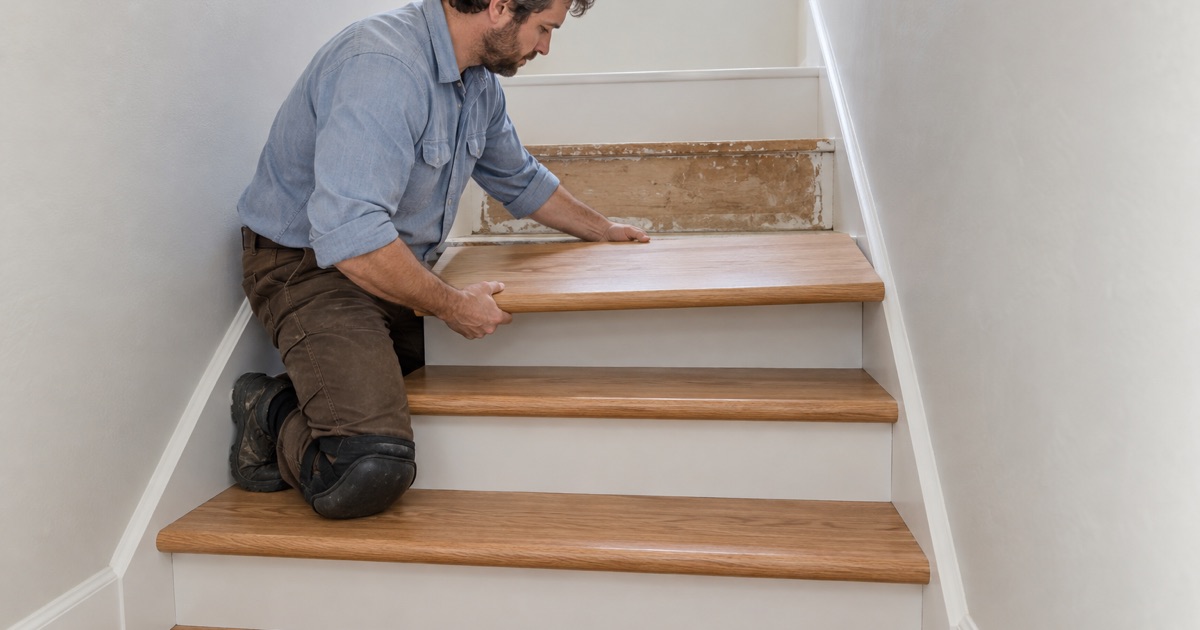
We start by pulling back carpet on one or two steps. Some stairs have finished hardwood treads underneath, which can be sanded and refinished. Many have rough construction treads of pine, particleboard or plywood, with a rounded nosing shaped only to hold carpet, and those need new hardwood. Knowing which type you have before pricing avoids surprises halfway through the job, when a staircase that looked refinishable turns out to be framing lumber.
Cutting Back the Old Nosing
To install new treads on a carpet-grade staircase, the protruding nose of each rough tread is cut flush with the riser below. That creates a flat, square step for the new tread and riser to sit on. New treads are then cut to exact width for each step, since stair widths often vary by a fraction from top to bottom.
Retread Systems and Solid Treads
Retread treads are made to fit over existing stairs and come with a matching riser, giving a finished look without rebuilding the staircase. Full-thickness solid treads replace the old treads entirely where the framing allows. We recommend one or the other based on the stair structure, the height of the existing steps and the look you want.
Treads, Risers and Nosings
Stair Nosing and Bullnose Treads
The nosing is the front edge of each tread that overhangs the riser. A bullnose tread has a fully rounded edge, while a square or eased nosing looks more contemporary. At the top of the stairs, a flush stair nosing makes a clean transition from the upper floor to the first step.
Nosing profile is partly a style choice and partly a matter of how the stairs feel underfoot. A rounded bullnose is forgiving on bare feet and hides small dents, while a crisp square edge shows every knock from a vacuum or a suitcase. We bring profile samples so you can run a hand along each before deciding.
Riser Options
Stair risers can be hardwood matched to the treads for a continuous wood look, or painted white for contrast. Painted risers hide scuffs from shoes differently than stained wood and suit many traditional interiors. We install the risers first and fit each tread tight against them.
Open Stairs and Return Nosings
Where a staircase is open on one side, each tread needs a return nosing so the finished edge wraps around the exposed end. Open stairs also involve fitting around balusters and a skirt board, adding labor per step. We plan any railing removal and reinstallation in the estimate.
Balusters that were set into the old rough treads usually have to be removed and reset into the new ones, and some are too short once the tread height changes. We check each baluster and the newel post connection before quoting, so railing work does not appear as an extra halfway through the conversion.
Species, Stain and Finish on Stairs
Red Oak, White Oak and Hickory Treads
Red oak and white oak are widely used for stair treads and are easy to match to existing oak floors. Hickory has a high Janka hardness rating and strong color variation that suits rustic floors. We match treads to the floor they meet, not just to the room. When stairs connect two different floors, such as tile downstairs and hardwood upstairs, we usually match the upper floor so the transition at the top reads as continuous.
Finishes That Stand Up to Stairs
Stairs take concentrated wear in the same spot on every step. We use durable waterborne finish systems that fit the South Coast AQMD Rule 1113 limit for wood coatings and apply enough coats for stair traffic. Matte and satin sheen levels hide wear better and feel less slippery than gloss.
Stair Runners Over Hardwood
A runner down the center of hardwood treads adds grip and softens noise while leaving the wood visible at the sides. If a runner is planned, we can finish the center of the treads accordingly and coordinate spacing with the runner installer. Runners also protect the finish in the lane where most wear happens, which extends the time before the stairs need another refinish.
Refinishing Existing Hardwood Stairs
Hand Sanding Each Tread
Large sanders cannot reach most of a staircase, so refinishing stairs is detailed hand and small-machine work around nosings, risers and balusters. Each tread is sanded, stained if needed and finished. That is why stair refinishing is priced per step even when the floor is priced by area.
Filling Tack Strip Holes
Stairs that were once carpeted have staple and tack strip holes along the back of each tread and the face of the risers. We fill them with color-matched filler before finishing, or recommend new risers and treads when the damage is too visible.
Scheduling Around Occupied Homes
Finishing stairs cuts off one level of the house until the coats dry. We sequence the work so at least a short window exists to cross the stairs, or finish alternate steps on alternate days where the household needs access. The written cure schedule says exactly when stairs can take normal use.
- 20+ Years of Wood Floor Work
- Free In-Home Estimates
- Dust-Contained Sanding