
Diamond Bar Wood Flooring repairs hardwood floor water damage in Diamond Bar, CA, and our crew has more than 20 years of experience bringing wet, cupped and stained floors back, serving surrounding cities including Walnut, Rowland Heights, South San Jose Hills, Pomona and Brea. A leak rarely destroys a wood floor outright; what ruins it is repairing in the wrong order.
The typical call starts with a dishwasher supply line, a refrigerator ice maker, a toilet or a water heater, or with boards slowly rising along a hallway where no water was ever seen. The second kind can mean a slab leak, and it needs a plumber before it needs a flooring contractor.
Our sequence does not change: find and stop the source, measure moisture, document the damage, let the floor dry and only then decide which boards can be saved. That order keeps good wood in place and keeps a repaired floor from failing a second time.
Finding the Water Before Replacing Boards
Tracing the Leak Source
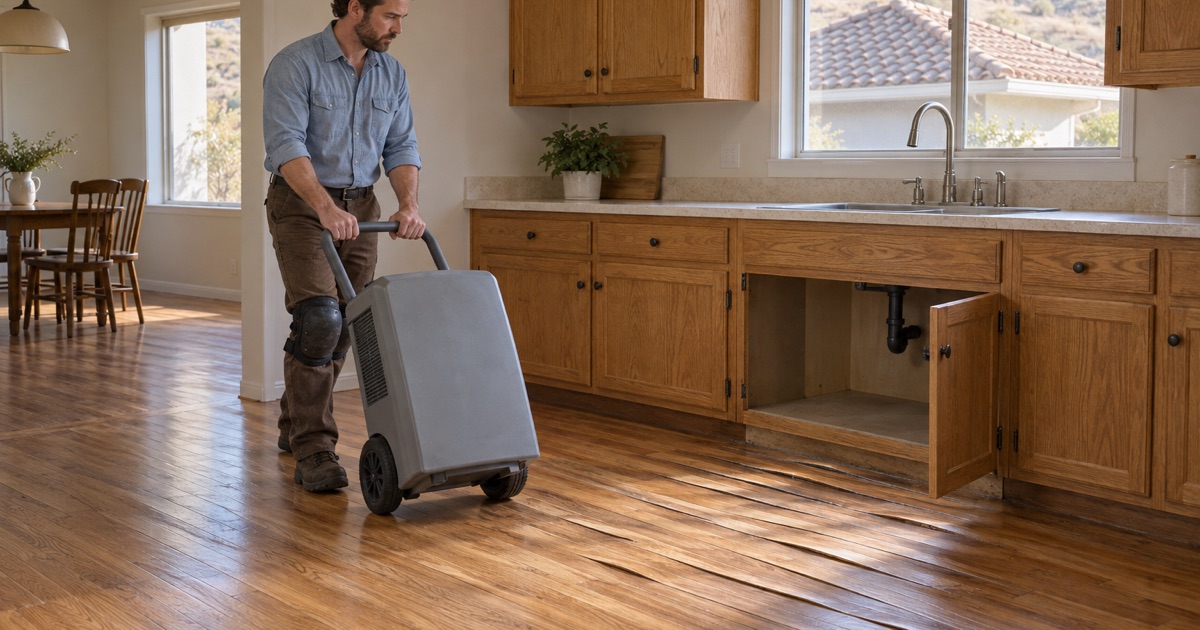
Water travels along subfloor seams, under cabinets and across a slab before it shows up in a floor, so the wet boards are not always above the leak. We follow the moisture readings back toward plumbing lines, appliances and exterior walls to find where it began. When the source is hidden in a wall or under concrete, we bring in a plumber before any flooring comes up.
This matters because a floor replaced over an active leak fails the same way, often within weeks. The repair budget goes further when the first dollars go to the cause.
Slab Leaks Under Wood Floors
A pinhole in a water line buried in a concrete slab can wet a floor from underneath for weeks before anyone notices. Warm spots, a water bill that climbs without explanation, or boards that cup or buckle in one area with no visible spill all point toward a slab leak. A leak detection company confirms it, and the repair has to be completed and dried out before a glue-down or floating floor returns. We coordinate with the plumber on where the slab will be opened, so the flooring removal is kept to the area that has to come up.
Moisture Mapping with Meters
We use a pin moisture meter in the boards and the plywood subfloor, and a pinless meter to scan wide areas quickly, recording readings on a sketch of the room. Readings from an unaffected room of the same floor give us the dry baseline. On concrete, an in-situ relative humidity test following ASTM F2170 shows the moisture inside the slab, which matters before any new wood is installed over it.
Cupping, Crowning and Buckling After a Leak
Why Boards Cup
When the underside of a board absorbs more water than the finished top, the bottom swells and the edges curl up. Cupping is the most common sign of a leak below or beside the floor, and it is often reversible once moisture evens out. We monitor cupped boards through the drying period, since many relax back close to flat without replacement.
If the boards flatten, a sanding and refinish can remove the remaining edge lift and the gray marks water leaves on the surface. If they stay deformed after drying, replacement is the right call.
Crowning From Sanding Too Soon
Crowning, where the center of each board sits higher than its edges, often comes from sanding a cupped floor before it dried. The raised edges were sanded off, and as the wood dried and shrank, the thinner edges dropped below the center. A crowned floor has lost wood that cannot be replaced, so the best fix is avoiding the mistake.
Buckled Floors and Expansion Space
Buckling happens when boards absorb enough water to swell against each other and walls, then lift completely off the subfloor. Boards installed tight to the wall with no expansion space are more vulnerable. Buckled sections almost always come out, and we check the fasteners and subfloor underneath because the lifting often tears them free. When we reinstall, the expansion gap around the room is restored and hidden under base molding, so a future spill does not have the same result.
Drying, Replacing and Refinishing
Drying the Floor and Subfloor
Once the source is stopped, drying equipment and time do most of the work. We keep track of readings at the same marked points until they come back in line with the dry baseline. Boards and subfloor that are left wet can grow mold and weaken, so a subfloor that stays wet beyond reasonable drying is opened up and inspected. We also avoid drying too fast with heat, which dries the top of the boards before the bottom and can pull a floor from cupping straight into cracks.
Replacing Boards That Will Not Recover
Boards that stay cupped, have turned black from long exposure or have delaminated in the case of engineered hardwood are cut out and replaced. New boards are matched in species, width, cut and grade and woven into the surrounding floor so the joints are staggered. Any soft or swollen subfloor is cut back to sound material and replaced before new flooring goes in.
Refinishing So the Repair Blends
New boards and water-marked old ones rarely match until the whole area is sanded and finished together. We sand the repaired area and the connected floor to fresh wood, stain to match if the floor is stained, and apply a finish that fits the South Coast AQMD Rule 1113 wood coatings limit. You get a written cure schedule so furniture does not return too early.
Documentation for Insurance Claims
Photos and Moisture Records for the Adjuster
We photograph the damage before anything is removed, record moisture readings with their locations and note the boards and subfloor that are affected. That record goes to you in writing so your adjuster can compare it with their own inspection. Clear documentation keeps the discussion on facts.
What we never do is tell you whether your policy covers a loss. That depends on your policy language and the cause, and it is your insurer’s call.
Matching and Uniform Appearance
When water damages part of a floor that runs continuously through several rooms, replacing only the damaged boards can leave a visible mismatch. California’s fair claims settlement regulation, 10 CCR 2695.9, speaks to replacement that results in a reasonably uniform appearance. We note in our scope where the floor is continuous so that question can be raised with the insurer on the record.
Smoke and Ash With Water Damage
Fires bring water damage from suppression along with smoke and ash residue. The EPA advises misting ash lightly before cleaning, wet mopping with as little water as possible and using a HEPA vacuum on dusty surfaces, which protects the finish from both scratching and extra moisture. The California Department of Insurance told insurers in a March 2025 bulletin that denying a smoke damage claim without an appropriate investigation is not reasonable, so documenting both kinds of damage helps.
- 20+ Years of Wood Floor Work
- Free In-Home Estimates
- Dust-Contained Sanding