
Diamond Bar Wood Flooring handles hardwood floor repair in Diamond Bar, CA, with more than 20 years spent fixing, patching and refinishing wood floors, and we work throughout surrounding cities including Walnut, Rowland Heights, South San Jose Hills, Pomona and Brea. Most floors that look ruined are a handful of bad boards away from looking right again, and a careful repair costs a fraction of a new floor.
The repairs we are called for most often are boards stained by pets or plants, gouges from moving day, squeaks in hallways, gaps that never closed and boards weakened by termites. Each has a different cause, and treating the symptom without the cause usually brings the same call back within a year.
So every repair starts with a diagnosis. We identify the species and cut of your floor, find the reason the damage happened, and tell you whether a spot repair will blend or whether the room needs to be refinished around it.
Replacing Damaged Boards So the Repair Disappears
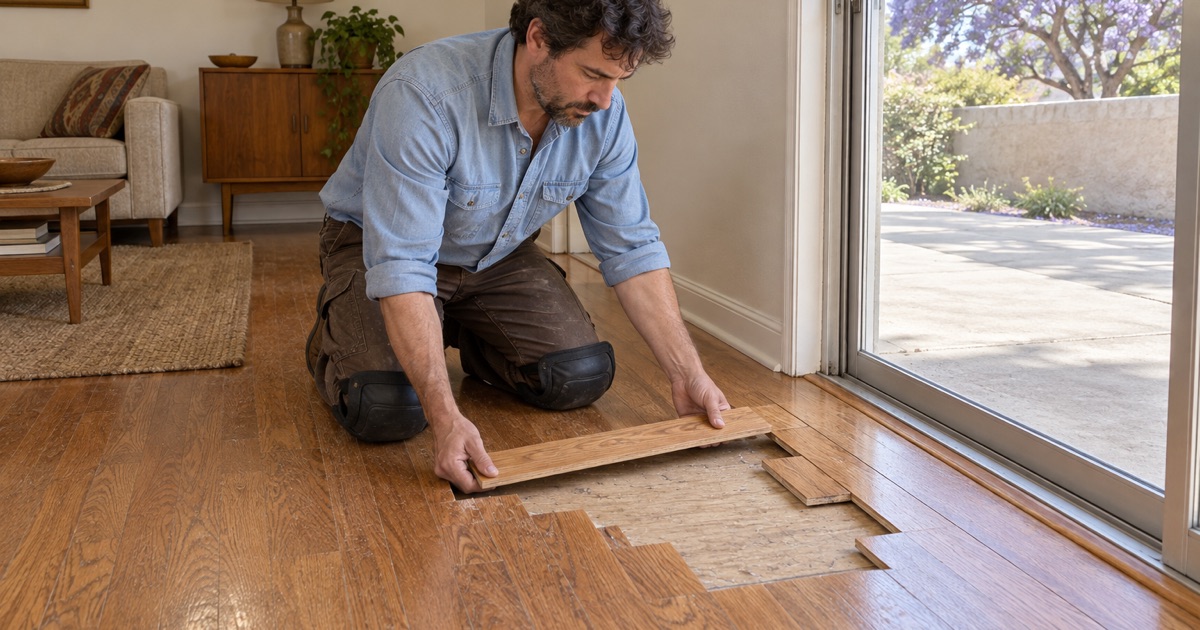
Board Replacement and Weave-In Repair
A damaged strip is cut out along its length with a saw set to the board thickness, and the pieces are chiseled free without disturbing the boards around it. New boards are trimmed so their bottom groove lip lets them drop into place, then glued and fastened. For a larger area, we use a weave-in repair, staggering the ends of new boards into the existing floor so there is no straight seam for the eye to catch.
A straight-cut patch is the most common sign of a rushed repair. Staggered joints, matched to the spacing of the original floor, make the repaired area read as part of the original installation.
Matching Species, Cut and Grade
Red oak and white oak look similar until they are stained side by side, and a plain-sawn board beside a quarter-sawn one shows a completely different grain figure. We match all three, along with board width and select grade or character grade, before any new wood goes down. Where exact stock cannot be found, we borrow original boards from inside a closet and put new wood there instead.
We also check how much the existing floor has been sanded over its life. A floor that has lost thickness needs new boards milled or sanded down so the repair sits flush.
Blending Color and Finish
New wood is always lighter than boards that have aged under sunlight and finish for years. Once repairs are installed, we either refinish the whole room so everything is sanded to fresh wood at once, or feather in stain and finish when only a small area is involved. We explain which will look better on your particular floor before the work is scheduled.
Open floor plans make this decision harder, because a kitchen, dining area and hallway often run as one continuous floor with no doorway to stop at. In those houses a repair in the kitchen usually means refinishing the whole connected area, and we say so up front rather than after the patch stands out.
Pet Stains, Gouges and Surface Wear
Pet Urine and Gray Boards
When urine soaks past the finish, it reacts with the tannins in oak and turns the wood gray or black, and the stain often runs deeper than sanding can reach. We probe the stained boards to see how far the discoloration goes. Boards that will not sand clean are replaced rather than bleached, because bleaching leaves a pale ghost that shows through stain.
Pet damage rarely stops at one spot. We check the whole floor under good light so all stained boards are replaced in one visit, not discovered one at a time after the refinish.
Scratches, Dents and Moving-Day Gouges
Scratches that sit in the finish layer respond to a screen and recoat, while scratches through to bare wood need sanding. Deep gouges from dragged appliances or dropped tools usually mean replacing that board. Small dents in soft species can sometimes be steamed up, but on most floors a new board gives the more reliable result.
The Janka hardness rating of the species tells part of the story. Harder woods such as hickory and maple resist denting better than softer species, although no hardwood is immune to a dropped cast-iron pan. When a household has large dogs or heavy furniture, we talk through finish and felt pads as well as the repair itself.
Sun Fading and Water Rings
Light marks and white rings from plants or glasses often sit in the finish and can be removed. Dark rings and gray patches have reached the wood. We test each area before quoting so you know which marks will come out with finish work alone and which boards need to be replaced.
Squeaks, Gaps and Loose Boards
Fixing Squeaks from Above or Below
Where there is a crawlspace or open ceiling below, we refasten the subfloor to the floor joists and add shims or blocking where boards rub. From above, we drive fine trim screws or cleats into the joists at the noisy spots and fill the holes to match. Both methods fix the cause, the movement, rather than lubricating the noise. Squeaks that come back across a wide area usually point to a subfloor problem, which we evaluate separately.
Gaps Between Boards
Seasonal gaps that open in dry weather and close again in humid months are normal wood movement. Gaps that stay open year-round usually come from boards installed too wet, a subfloor that has moved or fasteners that have loosened. We can fill permanent gaps with slivers of matching wood glued to one side, which move with the floor rather than cracking out like filler.
Before choosing a fix, we take moisture readings in the boards and subfloor. Filling a gap in a floor that is still drying out can lead to crowning when the wood swells back, so timing the repair to the season and the readings avoids trading one problem for another.
Loose and Lifting Boards
Nail-down boards that lift usually lost their flooring cleats or flooring staples, often because the subfloor underneath softened or shrank. Glue-down boards that lift have lost their bond. We refasten or reglue, and if moisture caused it, we find the source before the fix goes in.
Termite and Beetle Damage in Wood Floors
Drywood Termite Signs: Frass and Kick-Out Holes
Drywood termites live inside the wood they eat and push their droppings out through small kick-out holes, leaving piles of hard pellets known as termite frass. In a floor, you may see the pellets along a baseboard or under a hole in a board, and a screwdriver may sink into what looks like solid wood. A 1998 California Structural Pest Control Board fact sheet lists sawdust-like droppings, damaged wood and swarming winged insects as warning signs.
We document what we see with photos and refer you to a licensed pest control company to confirm and treat. Replacing boards before treatment only feeds an active colony.
Tent Fumigation and Heat Before Board Replacement
That same state fact sheet says fumigation and heating the entire house are the only options that ensure eradication throughout the structure, while spot treatments are not designed for whole-house eradication. Your pest company decides which is right. Once treatment is complete, we remove and replace the damaged boards and check the subfloor beneath for further damage.
Powderpost Beetles in Hardwood
Powderpost beetles leave fine, flour-like powder and very small round exit holes, a different sign from the pellets drywood termites produce. They can turn up in older or reclaimed hardwood, and their damage calls for a different conversation with a pest professional. We point out the difference and refer identification and treatment to a licensed pest professional before repairs.
- 20+ Years of Wood Floor Work
- Free In-Home Estimates
- Dust-Contained Sanding